protein
By Chinwe of Hair and Health
Protein conditioners.  Many naturals can do without them but some of us need them. If you are trying to determine where you fall, check out these four common reasons you may consider protein conditioners:
1. Your hair is chemically colored or bleached
Color treatments – particularly permanent ones – lift the scales of the cuticle and interact with the cortex to alter the natural pigment. Bleaches work similarly but tend to be more traumatic on the hair.  For some naturals, this process of lifting the cuticle scales may leave the hair weakened and/or prone to dryness.  Regular protein treatments can temporarily fill gaps in the cuticle, allowing for strengthened hair that retains more moisture.  If your hair is severely damaged, however, it may be best to cut.
2. You use direct heat (especially regularly)
Even with appropriate use of direct heat, the hair may still suffer some damage to the scales of the cuticle.  In this case, using a protein conditioner prior to a heat straightening session can help the hair sustain manipulation.  (Do not expect aprotein conditioner to do much, if anything, for you if you misuse direct heat.)  The protein can also temporarily fill gaps in the cuticle.
3. Your hair is more than 2 years old 
When the ends of your hair have been with you for two years, it is not uncommon to see ends that are worn down to the last cuticle layer or cortex … or split.  (Imagine the amount of wear and tear that has accumulated over that time frame!)  In some cases, a trim is all that is needed while in others a trim followed by regular protein conditioning thenceforth may be what is required.  The latter case is especially true for many of those who are BSL or beyond that are struggling to grow their hair even longer.  Regular use of protein conditioners can help to reduce breakage of the ends – the oldest, most worn segment of your hair.
4. You have fine strands
Now, not every fine-haired natural needs to incorporate protein conditioners, but for some it may be very useful towards reducing breakage during manipulation (e.g., styling, detangling).  Why?  This is because, in fine strands, both the cuticle and cortex are thinner than in thicker strands.  Consequently, fine hair has less natural strength and is more prone to damage.
Ladies, do you use protein conditioners?  Share below!
remove crochet braids

After removing your crochet braids, surely you want to retain all of the beautiful hair that you have grown over the month so you want to make sure that is done the right way. But before we talk about the removal process, let’s me share some tips on properly installing crochet braids without damage. You can find these tips here.

Being that this style essentially requires that you tie knots to secure the hair onto your real hair, there is tons of room for error when it comes to removing this style, so you will want to proceed with caution. For those who are newbies to wearing crochet braids the removal process altogether may be new territory for you. Fortunately the take down process is actually quite simple, here is what you need to know:

  • Use an oily product or anything that will help to give your hair some slip to avoid damage.
  • You will be cutting the hair extensions until they are very close to the knots that are attached to your cornrows.
  • If you threaded your cornrows down in the back of your hair, you are definitely going to want to take your time when removing. You can use an extra mirror so you can see what is going on in the back of your hair before proceeding to remove the thread.
  • After you have cut the hair you will undo the knots by gently picking them out with a comb or your hands.
  • For some sections you may need to only remove the knots by simply taking your cornrows down.
  • Have patience! You may encounter some areas that are harder than others to remove.
Here is a good look at what the process looks like:
When we are ready to remove our protective styles, sometimes we are so itching (literally) to get this style out, that we the pay the price of causing damage to our real hair. I know you want relief, but you need to be gentle and patient during the removal process. Remove your crochet braids on a day where you have a plenty of time and there is no rush. In comparison to other protective styles crochet braids can be removed in as little as 30 minutes, at the most an hour. Which really isn’t that bad considering how time consuming other styles like box braids or kinky twists can be.

The Tuareg in Niger
When I was a young girl, my mom would sometimes style my hair in what many of you now recognize as “African threading“.  The threaded style has a history of popularity in Africa, but is certainly not the only unique style of that region.  Here are some more beautiful looks from around the continent.
1. Braided hair of the Tuareg women (primarily in Niger)
Tuareg are a semi-nomadic group and mainly live in the southwestern parts of Niger, Mali, Burkina Faso, Libya, and southern region of Algeria.  One common hair style of the women and girls is the beautiful braided styles close to the scalp as seen in the following photo.  The women primarily keep their hair styles covered while the girls do not.

Photo sources: agadez-niger.com, delcampe.net, flickr
2. Braided hair of the Wodaabe (subgroup of Fulani — Nigeria, Guinea, Cameroon, Niger)
Wodaabe, a subgroup of Fulani, are traditionally nomadic with migrations extending through southern Niger, through northern Nigeria, northeastern Cameroon, southwestern Chad, and the western region of the Central African Republic.  Many of the women and girls wear a braid on each side with the crown and bang hair sculpted into a pompadour-like structure.
Wodaabe People
Photo sources: http://www.agadez-niger.com
3. Ochre twists of Hamar women (Ethiopia)
The Hamar inhabit the Omo River Valley in southwestern Ethiopia. According to one source (Ardi Ethiopia), the Hamar women “illustrate their welfare and health by mixing together ochre, water and binding resin, rubbing the mixture into their hair, and then twisting the strands to create coppery colored tresses known as goscha”.
Hamar Tribe
Photos from: http://www.johangerrits.nl, http://luminous-landscape.com, pipermackayphotography.com, nationalgeographic.com
4. Intricate braids of the Amhara and Tigray-Tigrinya (Ethiopia, Eritrea)
Tigray-Tigrinya live in the northern highlands of Ethiopia and southern and central parts of Eritrea while the Amhara inhabit the northern and central highlands of Ehtiopia.  Women and girls from both groups commonly wear strikingly intricate ‘cornrow’ styles with hair left out in the back as seen in the following collage.  According to Tigrai Online:
“Women in Tigrai [Tigray] might wear a variety of hairstyles based on their age and marital status. Young girls shave their hair on the side of their head leaving some hair at the back of the head and around the head. The shaved part slowly closes over the years.  By the time a young lady is married and has a kid she officially enters womanhood and she wears the fully braided hair do. There are many styles of braiding from the very fine called gilbich to a course one called albaso.
Amhara and Tigray-Tigrinya
Amhara (on the right) and Tigray-Tigrinya (on the left). Photo sources: beautiesofafrique.tumblr.com, kwekudee-tripdownmemorylane.blogspot.com
More Tigray
More Tigrays: “There are many styles of braiding from the very fine called gilbich to a course one called albaso.” Source: tigraionline.com
5. Coated plaits of Mumuhuila women (Angola)
Finally, Mumuhuila (or Mwila) are indigenous to southern Angola and the women are known for their intriguing hair style.   According to photographer Eric Lafforgue (linked on Beautiful Afrique):
“The women coat their hair with a red paste called, oncula, made of crushed red stone. They also put a mix of oil, crushed tree bark, dried cow dung and herbs on their hair. Their hair is decorated with beads, cauri shells (real or plastic ones) and dried food. Having their forehead shaved is considered as a sign of beauty. The plaits, which look like dreadlocks are called nontombi and have a precise meaning.Women or girls usually have four or six nontombi but when they only have three it means that someone died in their family.”
Mumuhuila tribe of Angola
Photo sources: beautiful-afrique.tumblr.com, http://www.john-kenny.com, www.ericlafforgue.com
What other unique African styles do you know about?
by Trudy of 4cHairChick
Currently, I’m ballin’ on a tight budget.  Got some big time projects in my future, so every dollar spent is carefully planned.  Though a Huetiful Steamer is in the horizon; I’m currently without a steamer or an upright hair dryer to aid me in my deep conditioning routine. With my 4c curls, skipping deep conditioning is not an option (I need all the moisture I can get), so I had to figure out a solution for heating my hair during deep conditioning sessions since I don’t have an upright hair dryer or steamer.
Though you can definitely deep condition with body heat only, I used to do that, my results were much better when I used additional heat.  Below is my crafty yet classy solution for heating your hair during deep conditioning sessions without a dryer.
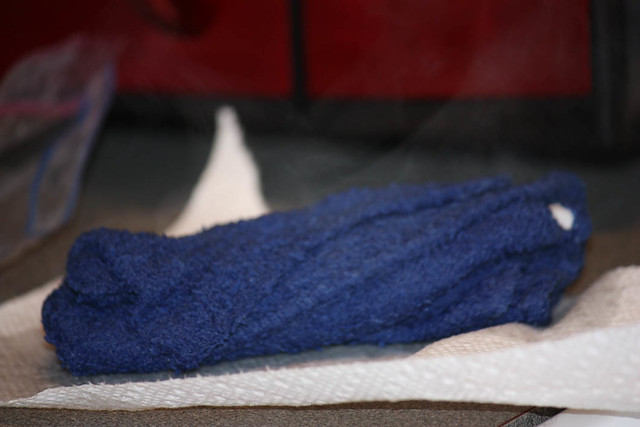
The Face Towel Method Heat a face towel in the microwave. (30 – 40 seconds will do.)
HeatSteaming towel
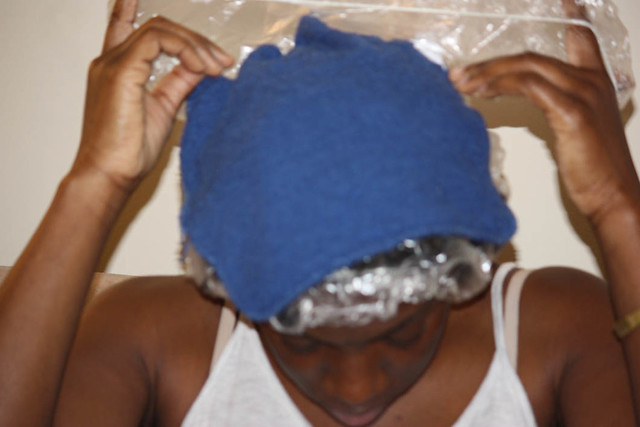
Next, put a shower cap over your hair.
Place the steaming face towel on top of the shower cap.
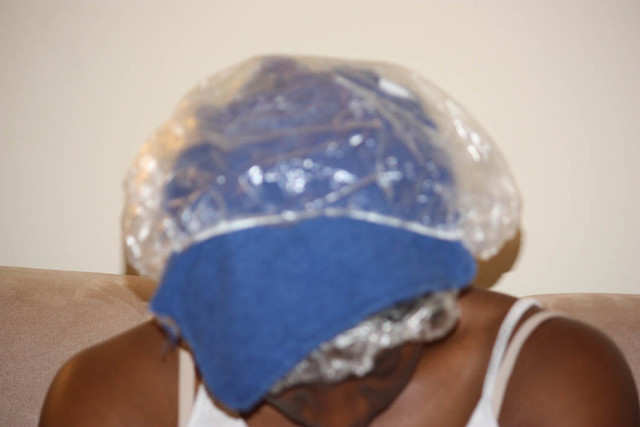
Seal in the heat from the face towel by placing another shower cap on over the firstshower cap.
*Note – Don’t be like me in this picture – put a towel around your neck. I got burned by water drops from the face towel and it was NOT fun. coveredNice
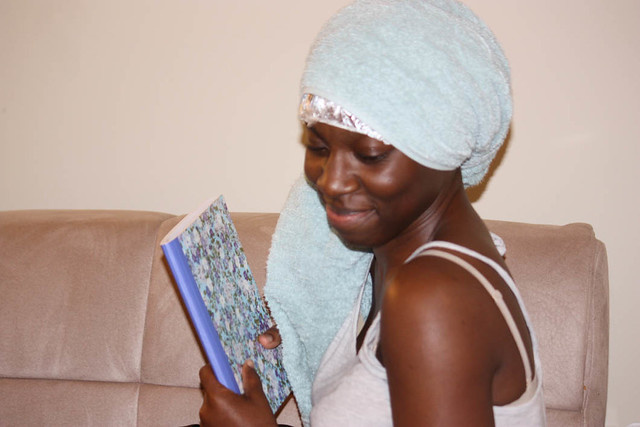
Boom, there it is – improvised heat!  The face towel will stay hot for about ten minutes.  I wrap my head with a bath towel in addition to using the steamy face towel and shower caps.


After 30 minutes, my hair is good to go and deep conditioned. wrapped and ready
Heat is an important part of deep conditioning because heat lifts your hair cuticles.  The lifted cuticles enable the deep conditioning products to penetrate the hair shaft.
How do you deep condition your hair? Dryer, Steamer or another method?

Subscribe to RSS Feed Follow me on Twitter!